Buy mtume.com ?
We are moving the project
mtume.com .
Are you interested in purchasing the domain
mtume.com ?
domain@kv-gmbh.de · 0541-91531010
Buy mtume.com ?
What are harmonic oscillations?
Harmonic oscillations are repetitive back-and-forth movements or vibrations that follow a specific pattern. They are characterized by a sinusoidal or wave-like motion, where the displacement of the oscillating object from its equilibrium position is proportional to the restoring force acting on it. Examples of harmonic oscillations include the swinging of a pendulum, the motion of a mass-spring system, and the vibrations of a guitar string. These oscillations are important in many areas of physics and engineering, as they can be used to describe and analyze various natural and mechanical systems. **
How do you draw oscillations?
To draw oscillations, you can start by plotting a sinusoidal function on a graph. The function can be in the form of y = A*sin(Bx + C) or y = A*cos(Bx + C), where A is the amplitude, B is the frequency, and C is the phase shift. You can then plot the points on the graph by plugging in different values of x to see how the function oscillates. Additionally, you can use a ruler to connect the points to create a smooth oscillation curve. **


Similar search terms for Oscillations
Top-Angebote
Products related to Oscillations:
-
Texas Instruments Ti-1726 LommeregnerTexas Instruments TI-1726 Miniskrivebordslommeregneren med attraktiv udformning og SuperView-display. Specifikationer: Stort, 8-cifret (12,5 mm) LCD SuperView-display. Rummeligt tastatur med velplacerede gummiknapper. Knap til (+/-) Knap til kvadratrod Vinklet display gør det nemmere at aflæse. ANYLITE™ solcelledrift. Kan anvendes selv i dårligt lys. str. 80 x 110 mm Vægt: 95 gram140,00 DKK*Shipping: 81,19 DKKSecure redirect to the provider
-
Texas Instruments Ti-1795 Sv BordregnerTexas Instruments TI-1795 SV bordregner Den klassiske mini desktop-regnemaskine med store taster og ekstra stort SuperView display til hjemmet, kontoret eller forretningen. Skråtstillet LCD SuperView display med store tal (14 mm) sikrer god læsbarhed. God plads mellem tasterne, konturtaster og store profiltaster, der giver nem betjening. Skift af fortegn (+/-). Sol- og batteridrevet fungerer overalt. Mål: 14 x 12,2 x 2 cm238,75 DKK*Shipping: 81,19 DKKSecure redirect to the provider
-
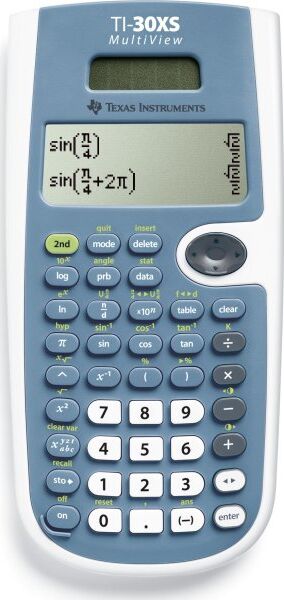
Texas Instruments Ti-30xsmv Matematisk LommeregnerTexas matematikregner TI-30XS Multi-View TI-30XS MultiView™ er den nye videnskabelige lommeregner, som kombinerer de kendte statistiske og videnskabelige funktioner fra den klassiske TI-30 med et flerlinjes (Multi-line) display. TI-30XS MultiView™ fungerer og skriver resultater, som du forventer det. Brøker skrives for eksempel på en rigtig brøkstreg som i lærebøgerne. Specifikationer De vigtige videnskabelige, trigonometriske og hyperbolske funktioner. Multi-linje skærm, så for eksempel brøker skrives naturligt, og du kan se tidligere indtastninger. To-variabel statistik: Indtast / slet / indsæt / editer individuelle statistiske data. "Equation Recall" funktion gør det muligt at genkalde, se og ændre tidligere udregninger og statistiske data. Se og tast brøker på rigtige brøkstreger, som decimaltal eller en blanding. Vælg selv. Dataeditor til at indtaste lister med data. Liste funktion: Kan anvende en funktion på en liste af værdier. Rødder vises, så du kan arbejde med rødder eksakt, og de kan bruges til at faktorisere nævneren i en brøk. Eksponenter skrives med hævet skrift (superscript). Konvertering er gjort stærkere med en Mode Menu: Indstil forskellige måder at se tal på (Grader / Notationer / flydende antal decimaler). Videnskabelig (Scientific) notation. Arbejd med variable og gem værdier i dine variable. Passer til brugere på: 7.-10. klasse, Gymnasiet og HF, HTX og HHX, Universitet Vægt: 238,3 gram373,75 DKK*Shipping: 81,19 DKKSecure redirect to the provider


-
How do damped oscillations work?
Damped oscillations occur when an external force or frictional resistance acts upon a vibrating system, causing the amplitude of the oscillations to decrease over time. This damping effect gradually reduces the energy of the system, resulting in the oscillations eventually coming to a stop. The rate at which the oscillations decay is determined by the damping coefficient, with higher damping leading to faster decay. Damped oscillations are commonly observed in various systems, such as springs and pendulums, where energy is gradually dissipated due to external factors. **
-
What are resonance-driven oscillations?
Resonance-driven oscillations occur when a system is subjected to an external force at its natural frequency, causing it to oscillate with increasing amplitude. This phenomenon is known as resonance, where the energy of the external force is transferred efficiently to the system, leading to large oscillations. Resonance-driven oscillations can be observed in various systems, such as mechanical, electrical, and acoustic systems, and are important in understanding the behavior of these systems under different conditions. **
-
How can sinusoidal oscillations be modeled?
Sinusoidal oscillations can be modeled using mathematical equations that describe the amplitude, frequency, and phase of the oscillation. The most common way to model sinusoidal oscillations is through a sine or cosine function, such as y = A*sin(2πft + φ), where A is the amplitude, f is the frequency, t is the time, and φ is the phase shift. By adjusting these parameters, we can accurately represent the behavior of sinusoidal oscillations in various systems and phenomena. Additionally, sinusoidal oscillations can also be modeled using differential equations in the context of dynamic systems analysis. **
-
What are examples of damped oscillations?
Examples of damped oscillations include a swinging pendulum in a viscous fluid, a car's suspension system responding to bumps on the road, and the motion of a spring-mass system with air resistance. In each case, the oscillations gradually decrease in amplitude over time due to the dissipative forces present, such as friction or air resistance. The damping effect causes the system to eventually come to rest at its equilibrium position. **

What are the trigonometric functions in oscillations?
In oscillations, the trigonometric functions commonly used are sine and cosine functions. These functions describe the relationship between the angle of rotation and the position of an object undergoing oscillatory motion. The sine function represents the vertical component of the motion, while the cosine function represents the horizontal component. By using these trigonometric functions, we can analyze and predict the behavior of oscillatory systems. **
Does a wave consist of multiple oscillations?
Yes, a wave consists of multiple oscillations. In physics, a wave is a disturbance that travels through a medium, transferring energy without transferring matter. This disturbance causes particles in the medium to oscillate back and forth, creating a pattern of repeated motion. Therefore, a wave is made up of multiple oscillations as it propagates through the medium. **
Top-Angebote
Products related to Oscillations:
-
Primal Rhythm Tohånds/switch Stang -# 4Rhythm - Let og præcis At mestre tohåndskastet handler i høj grad om at finde rytmen. Når først rytmen sidder, åbner der sig en verden af muligheder. Rhythm-serien er designet specielt til trout-spey på mindre åer og vandløb - ideel til steder, hvor begrænset plads til bagkastet ofte kan være en udfordring. Specifikationer: Højmoduls 55MSI klinger Optimeret til Skagit- eller Scandi-klumper Mat, lavglans stealth-sort finish UHC – Ultra Light Helical Core (ultralet spiralforstærket kerne) LNR – Longitudinal Fibre Alignment (langsgående fiberorientering) LMS – Low Mass Scrim (lavmasseforstærkning) Cordura-stangrør med bærestrop Stofpose til stangen 4-delt rejsedesign Modeller: 11' #4 - 169g 11' #6 - 184g2799,00 DKK*Shipping: 49,00 DKKSecure redirect to the provider
-
Texas Instruments Ti-1726 LommeregnerTexas Instruments TI-1726 Miniskrivebordslommeregneren med attraktiv udformning og SuperView-display. Specifikationer: Stort, 8-cifret (12,5 mm) LCD SuperView-display. Rummeligt tastatur med velplacerede gummiknapper. Knap til (+/-) Knap til kvadratrod Vinklet display gør det nemmere at aflæse. ANYLITE™ solcelledrift. Kan anvendes selv i dårligt lys. str. 80 x 110 mm Vægt: 95 gram140,00 DKK*Shipping: 81,19 DKKSecure redirect to the provider
-
What are harmonic oscillations?
Harmonic oscillations are repetitive back-and-forth movements or vibrations that follow a specific pattern. They are characterized by a sinusoidal or wave-like motion, where the displacement of the oscillating object from its equilibrium position is proportional to the restoring force acting on it. Examples of harmonic oscillations include the swinging of a pendulum, the motion of a mass-spring system, and the vibrations of a guitar string. These oscillations are important in many areas of physics and engineering, as they can be used to describe and analyze various natural and mechanical systems. **
-
How do you draw oscillations?
To draw oscillations, you can start by plotting a sinusoidal function on a graph. The function can be in the form of y = A*sin(Bx + C) or y = A*cos(Bx + C), where A is the amplitude, B is the frequency, and C is the phase shift. You can then plot the points on the graph by plugging in different values of x to see how the function oscillates. Additionally, you can use a ruler to connect the points to create a smooth oscillation curve. **
-
How do damped oscillations work?
Damped oscillations occur when an external force or frictional resistance acts upon a vibrating system, causing the amplitude of the oscillations to decrease over time. This damping effect gradually reduces the energy of the system, resulting in the oscillations eventually coming to a stop. The rate at which the oscillations decay is determined by the damping coefficient, with higher damping leading to faster decay. Damped oscillations are commonly observed in various systems, such as springs and pendulums, where energy is gradually dissipated due to external factors. **
-
What are resonance-driven oscillations?
Resonance-driven oscillations occur when a system is subjected to an external force at its natural frequency, causing it to oscillate with increasing amplitude. This phenomenon is known as resonance, where the energy of the external force is transferred efficiently to the system, leading to large oscillations. Resonance-driven oscillations can be observed in various systems, such as mechanical, electrical, and acoustic systems, and are important in understanding the behavior of these systems under different conditions. **
Similar search terms for Oscillations
-
Texas Instruments Ti-1795 Sv BordregnerTexas Instruments TI-1795 SV bordregner Den klassiske mini desktop-regnemaskine med store taster og ekstra stort SuperView display til hjemmet, kontoret eller forretningen. Skråtstillet LCD SuperView display med store tal (14 mm) sikrer god læsbarhed. God plads mellem tasterne, konturtaster og store profiltaster, der giver nem betjening. Skift af fortegn (+/-). Sol- og batteridrevet fungerer overalt. Mål: 14 x 12,2 x 2 cm238,75 DKK*Shipping: 81,19 DKKSecure redirect to the provider
-
Texas Instruments Ti-30xsmv Matematisk LommeregnerTexas matematikregner TI-30XS Multi-View TI-30XS MultiView™ er den nye videnskabelige lommeregner, som kombinerer de kendte statistiske og videnskabelige funktioner fra den klassiske TI-30 med et flerlinjes (Multi-line) display. TI-30XS MultiView™ fungerer og skriver resultater, som du forventer det. Brøker skrives for eksempel på en rigtig brøkstreg som i lærebøgerne. Specifikationer De vigtige videnskabelige, trigonometriske og hyperbolske funktioner. Multi-linje skærm, så for eksempel brøker skrives naturligt, og du kan se tidligere indtastninger. To-variabel statistik: Indtast / slet / indsæt / editer individuelle statistiske data. "Equation Recall" funktion gør det muligt at genkalde, se og ændre tidligere udregninger og statistiske data. Se og tast brøker på rigtige brøkstreger, som decimaltal eller en blanding. Vælg selv. Dataeditor til at indtaste lister med data. Liste funktion: Kan anvende en funktion på en liste af værdier. Rødder vises, så du kan arbejde med rødder eksakt, og de kan bruges til at faktorisere nævneren i en brøk. Eksponenter skrives med hævet skrift (superscript). Konvertering er gjort stærkere med en Mode Menu: Indstil forskellige måder at se tal på (Grader / Notationer / flydende antal decimaler). Videnskabelig (Scientific) notation. Arbejd med variable og gem værdier i dine variable. Passer til brugere på: 7.-10. klasse, Gymnasiet og HF, HTX og HHX, Universitet Vægt: 238,3 gram373,75 DKK*Shipping: 81,19 DKKSecure redirect to the provider
-
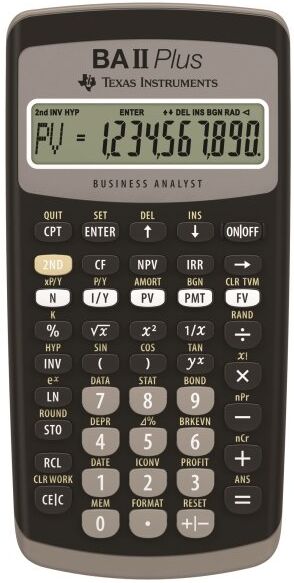
Texas Instruments Ba-Ii Plus FinansregnerTexas Instruments BA-II Plus Finansregner Ideel regnemaskine til statistik- og finansberegninger. Specifikationer Beregning af TVM (time-value-money) annuiteter, terminer, leasing/lejemål, opsparing mm. Generering af amortisationsplaner mm. Udføre pengestrømsanalyser for op til 24 forskellige pengestrømme med op til 4-cifrede hyppighede, beregner NPV og IRR. Statistik med en eller to variabler med fire regressionsindstillinger (lineær, logaritmisk, eksponentiel, og potens). Fire forskellige metoder til beregning af afskrivninger, bogført værdi og restværdi. Beregner også: balancepunkt, rentekonverteringer, delta %, avance og tab. De matematiske funktioner omfatter triognomiske beregninger, naturlige logaritmer og potenser.661,25 DKK*Shipping: 81,19 DKKSecure redirect to the provider
-
Texas Instruments Hp 17bii+ Finans LommeregnerHP 17bII+ Financial lommeregner. Finansregner især til brugere indenfor ejendomshandel og finansiering. Fysiske specifikationer LCD skærm med 2 linjer à 22 tegn. 28 KB RAM brugerhukommelse Mere end 250 nemt betjente funktioner Vælg mellem RPN og algebraisk indtastning Forretnings- og økonomiske faciliteter TVM (lån, opsparing og leasing) 3200 Cash flow funktioner – IRR NVP Annuiteter, amortisering, intern rente, aktier og afskrivning Register baseret Cash flow analyse SL DB SOYD nedskrivningsmetoder Statistik / Matematik Forecasting, valutaomregning, procenter m.m. Skriv og løs ligninger for enhver variabel Listebaseret statistik og forecasting med 2 variabler +, -, x, /, %, 1/x, +/-, 1n, SQRT x, ex, n!, yx, SUM x, SUM x2, SUM y, SUM y2, SUM xy, log, 10x, Pi, x2 Brugertilpassede faciliteter Menuer, prompts og meddelelser Ur med alarmer og aftaler HP Solve Tilbehør Infra-rød printer HP 82240B. Batterier 2 x CR2032 – varenummer GP39017.1121,25 DKK*Shipping: 31,19 DKKSecure redirect to the provider
-
How can sinusoidal oscillations be modeled?
Sinusoidal oscillations can be modeled using mathematical equations that describe the amplitude, frequency, and phase of the oscillation. The most common way to model sinusoidal oscillations is through a sine or cosine function, such as y = A*sin(2πft + φ), where A is the amplitude, f is the frequency, t is the time, and φ is the phase shift. By adjusting these parameters, we can accurately represent the behavior of sinusoidal oscillations in various systems and phenomena. Additionally, sinusoidal oscillations can also be modeled using differential equations in the context of dynamic systems analysis. **
-
What are examples of damped oscillations?
Examples of damped oscillations include a swinging pendulum in a viscous fluid, a car's suspension system responding to bumps on the road, and the motion of a spring-mass system with air resistance. In each case, the oscillations gradually decrease in amplitude over time due to the dissipative forces present, such as friction or air resistance. The damping effect causes the system to eventually come to rest at its equilibrium position. **
-
What are the trigonometric functions in oscillations?
In oscillations, the trigonometric functions commonly used are sine and cosine functions. These functions describe the relationship between the angle of rotation and the position of an object undergoing oscillatory motion. The sine function represents the vertical component of the motion, while the cosine function represents the horizontal component. By using these trigonometric functions, we can analyze and predict the behavior of oscillatory systems. **
-
Does a wave consist of multiple oscillations?
Yes, a wave consists of multiple oscillations. In physics, a wave is a disturbance that travels through a medium, transferring energy without transferring matter. This disturbance causes particles in the medium to oscillate back and forth, creating a pattern of repeated motion. Therefore, a wave is made up of multiple oscillations as it propagates through the medium. **
* All prices are inclusive of VAT and, if applicable, plus shipping costs. The offer information is based on the details provided by the respective shop and is updated through automated processes. Real-time updates do not occur, so deviations can occur in individual cases. ** Note: Parts of this content were created by AI.