Buy mtume.com ?
We are moving the project
mtume.com .
Are you interested in purchasing the domain
mtume.com ?
domain@kv-gmbh.de · 0541-91531010
Buy mtume.com ?
At what frequency do your instruments play?
Our instruments play at a frequency range of 20 Hz to 20,000 Hz, which covers the audible range for human ears. This range allows us to create a wide variety of sounds and music that can be enjoyed by listeners. We carefully tune and adjust our instruments to ensure that they produce the best possible sound within this frequency range. **
What is the difference between drums and percussion?
Drums are a specific type of percussion instrument that typically have a hollow body and a membrane that is struck to produce sound. Percussion, on the other hand, is a broader category that includes a wide range of instruments that are struck, shaken, or scraped to produce sound. While drums are a subset of percussion instruments, percussion encompasses a variety of instruments such as cymbals, tambourines, maracas, and xylophones. **


Similar search terms for Frequency
Top-Angebote
Products related to Frequency:
-
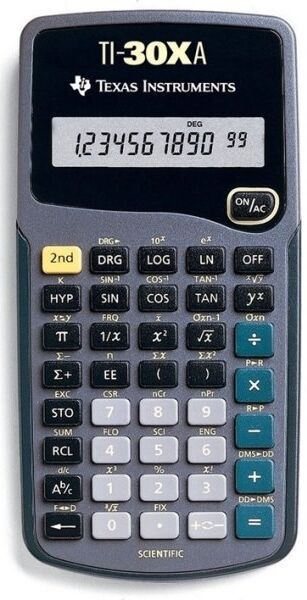
Texas Instruments Ti-30xa LommeregnerTexas Instruments TI-30XA Brøklommeregner med mulighed for konvertering af brøktal til decimaler og omvendt. Vinduesplads til 10 cifre og 2 cifre eksponenter. Display: 1 linjer / 10 tegn Batteri: LR44 (knapcellebatteri) AutoslukInternational version (tysk / fransk / engelsk / finsk / svensk / portugisisk)145,00 DKK*Shipping: 81,19 DKKSecure redirect to the provider
-
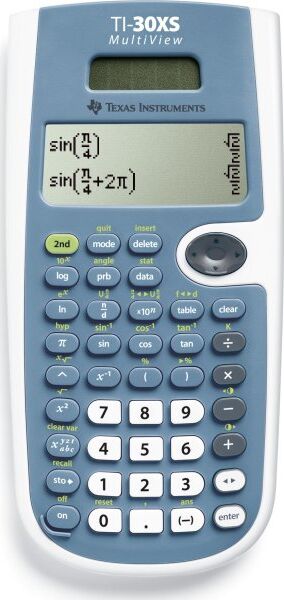
Texas Instruments Ti-30xsmv Matematisk LommeregnerTexas matematikregner TI-30XS Multi-View TI-30XS MultiView™ er den nye videnskabelige lommeregner, som kombinerer de kendte statistiske og videnskabelige funktioner fra den klassiske TI-30 med et flerlinjes (Multi-line) display. TI-30XS MultiView™ fungerer og skriver resultater, som du forventer det. Brøker skrives for eksempel på en rigtig brøkstreg som i lærebøgerne. Specifikationer De vigtige videnskabelige, trigonometriske og hyperbolske funktioner. Multi-linje skærm, så for eksempel brøker skrives naturligt, og du kan se tidligere indtastninger. To-variabel statistik: Indtast / slet / indsæt / editer individuelle statistiske data. "Equation Recall" funktion gør det muligt at genkalde, se og ændre tidligere udregninger og statistiske data. Se og tast brøker på rigtige brøkstreger, som decimaltal eller en blanding. Vælg selv. Dataeditor til at indtaste lister med data. Liste funktion: Kan anvende en funktion på en liste af værdier. Rødder vises, så du kan arbejde med rødder eksakt, og de kan bruges til at faktorisere nævneren i en brøk. Eksponenter skrives med hævet skrift (superscript). Konvertering er gjort stærkere med en Mode Menu: Indstil forskellige måder at se tal på (Grader / Notationer / flydende antal decimaler). Videnskabelig (Scientific) notation. Arbejd med variable og gem værdier i dine variable. Passer til brugere på: 7.-10. klasse, Gymnasiet og HF, HTX og HHX, Universitet Vægt: 238,3 gram373,75 DKK*Shipping: 81,19 DKKSecure redirect to the provider
-
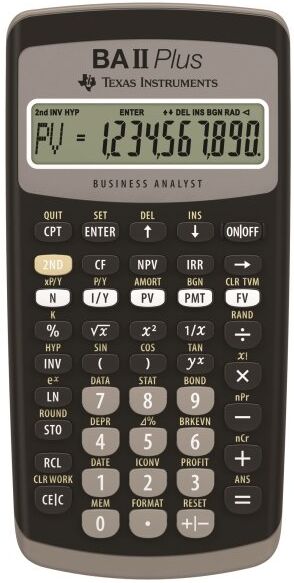
Texas Instruments Ba-Ii Plus FinansregnerTexas Instruments BA-II Plus Finansregner Ideel regnemaskine til statistik- og finansberegninger. Specifikationer Beregning af TVM (time-value-money) annuiteter, terminer, leasing/lejemål, opsparing mm. Generering af amortisationsplaner mm. Udføre pengestrømsanalyser for op til 24 forskellige pengestrømme med op til 4-cifrede hyppighede, beregner NPV og IRR. Statistik med en eller to variabler med fire regressionsindstillinger (lineær, logaritmisk, eksponentiel, og potens). Fire forskellige metoder til beregning af afskrivninger, bogført værdi og restværdi. Beregner også: balancepunkt, rentekonverteringer, delta %, avance og tab. De matematiske funktioner omfatter triognomiske beregninger, naturlige logaritmer og potenser.661,25 DKK*Shipping: 81,19 DKKSecure redirect to the provider
-
Texas Instruments Hp 17bii+ Finans LommeregnerHP 17bII+ Financial lommeregner. Finansregner især til brugere indenfor ejendomshandel og finansiering. Fysiske specifikationer LCD skærm med 2 linjer à 22 tegn. 28 KB RAM brugerhukommelse Mere end 250 nemt betjente funktioner Vælg mellem RPN og algebraisk indtastning Forretnings- og økonomiske faciliteter TVM (lån, opsparing og leasing) 3200 Cash flow funktioner – IRR NVP Annuiteter, amortisering, intern rente, aktier og afskrivning Register baseret Cash flow analyse SL DB SOYD nedskrivningsmetoder Statistik / Matematik Forecasting, valutaomregning, procenter m.m. Skriv og løs ligninger for enhver variabel Listebaseret statistik og forecasting med 2 variabler +, -, x, /, %, 1/x, +/-, 1n, SQRT x, ex, n!, yx, SUM x, SUM x2, SUM y, SUM y2, SUM xy, log, 10x, Pi, x2 Brugertilpassede faciliteter Menuer, prompts og meddelelser Ur med alarmer og aftaler HP Solve Tilbehør Infra-rød printer HP 82240B. Batterier 2 x CR2032 – varenummer GP39017.1121,25 DKK*Shipping: 31,19 DKKSecure redirect to the provider

-
What is the difference between natural frequency, excitation frequency, and resonance frequency?
Natural frequency is the frequency at which a system naturally vibrates when disturbed from its equilibrium position. Excitation frequency is the frequency at which an external force is applied to a system. Resonance frequency is the frequency at which the amplitude of the system's response is maximized when subjected to an external force at or near its natural frequency. In summary, natural frequency is inherent to the system, excitation frequency is the frequency of the external force, and resonance frequency is the frequency at which the system's response is maximized. **
-
Does the frequency affect the performance of my PC?
Yes, the frequency of your PC's processor can affect its performance. A higher frequency generally means that the processor can perform tasks more quickly, resulting in better overall performance. However, other factors such as the number of cores, cache size, and architecture also play a significant role in determining the performance of a PC. It's important to consider all these factors when evaluating the performance of your PC. **
-
What do you call music without instruments, drums, and bass?
Music without instruments, drums, and bass is often referred to as a cappella music. A cappella music is vocal music performed without instrumental accompaniment, relying solely on the voices of the singers to create the melody, harmony, and rhythm of the music. This style of music can range from traditional choral arrangements to contemporary pop and rock covers, showcasing the versatility and creativity of vocal performance. **
-
How can I determine the frequency of music?
The frequency of music refers to the number of vibrations per second that create the sound waves we hear. To determine the frequency of music, you can use a tool called a frequency counter or a software application that can analyze audio files. Alternatively, you can use a musical instrument tuner that displays the frequency of the note being played. By measuring the frequency of the sound waves produced by the music, you can determine the pitch and overall frequency of the music being played. **


What is the difference between angular frequency and frequency?
Frequency is the number of complete cycles of a periodic waveform that occur in a unit of time, usually measured in hertz (Hz). Angular frequency, on the other hand, is the rate of change of the phase of a sinusoidal waveform, measured in radians per second. Angular frequency is related to frequency by the equation ω = 2πf, where ω is the angular frequency and f is the frequency in hertz. **
Is the radio frequency 149050 a walkie-talkie frequency?
No, the radio frequency 149050 is not typically used for walkie-talkies. Walkie-talkies typically operate on frequencies within the VHF (Very High Frequency) or UHF (Ultra High Frequency) bands, such as 462-467 MHz in the UHF band. The frequency 149050 is within the HF (High Frequency) band, which is commonly used for long-distance communication, such as amateur radio, maritime, and aviation communication. Therefore, it is unlikely that 149050 would be used for walkie-talkies. **
Top-Angebote
Products related to Frequency:
-
Texas Instruments Ti-1726 LommeregnerTexas Instruments TI-1726 Miniskrivebordslommeregneren med attraktiv udformning og SuperView-display. Specifikationer: Stort, 8-cifret (12,5 mm) LCD SuperView-display. Rummeligt tastatur med velplacerede gummiknapper. Knap til (+/-) Knap til kvadratrod Vinklet display gør det nemmere at aflæse. ANYLITE™ solcelledrift. Kan anvendes selv i dårligt lys. str. 80 x 110 mm Vægt: 95 gram140,00 DKK*Shipping: 81,19 DKKSecure redirect to the provider
-
Texas Instruments Ti-30xa LommeregnerTexas Instruments TI-30XA Brøklommeregner med mulighed for konvertering af brøktal til decimaler og omvendt. Vinduesplads til 10 cifre og 2 cifre eksponenter. Display: 1 linjer / 10 tegn Batteri: LR44 (knapcellebatteri) AutoslukInternational version (tysk / fransk / engelsk / finsk / svensk / portugisisk)145,00 DKK*Shipping: 81,19 DKKSecure redirect to the provider
-
Texas Instruments Ti-30xsmv Matematisk LommeregnerTexas matematikregner TI-30XS Multi-View TI-30XS MultiView™ er den nye videnskabelige lommeregner, som kombinerer de kendte statistiske og videnskabelige funktioner fra den klassiske TI-30 med et flerlinjes (Multi-line) display. TI-30XS MultiView™ fungerer og skriver resultater, som du forventer det. Brøker skrives for eksempel på en rigtig brøkstreg som i lærebøgerne. Specifikationer De vigtige videnskabelige, trigonometriske og hyperbolske funktioner. Multi-linje skærm, så for eksempel brøker skrives naturligt, og du kan se tidligere indtastninger. To-variabel statistik: Indtast / slet / indsæt / editer individuelle statistiske data. "Equation Recall" funktion gør det muligt at genkalde, se og ændre tidligere udregninger og statistiske data. Se og tast brøker på rigtige brøkstreger, som decimaltal eller en blanding. Vælg selv. Dataeditor til at indtaste lister med data. Liste funktion: Kan anvende en funktion på en liste af værdier. Rødder vises, så du kan arbejde med rødder eksakt, og de kan bruges til at faktorisere nævneren i en brøk. Eksponenter skrives med hævet skrift (superscript). Konvertering er gjort stærkere med en Mode Menu: Indstil forskellige måder at se tal på (Grader / Notationer / flydende antal decimaler). Videnskabelig (Scientific) notation. Arbejd med variable og gem værdier i dine variable. Passer til brugere på: 7.-10. klasse, Gymnasiet og HF, HTX og HHX, Universitet Vægt: 238,3 gram373,75 DKK*Shipping: 81,19 DKKSecure redirect to the provider
-
At what frequency do your instruments play?
Our instruments play at a frequency range of 20 Hz to 20,000 Hz, which covers the audible range for human ears. This range allows us to create a wide variety of sounds and music that can be enjoyed by listeners. We carefully tune and adjust our instruments to ensure that they produce the best possible sound within this frequency range. **
-
What is the difference between drums and percussion?
Drums are a specific type of percussion instrument that typically have a hollow body and a membrane that is struck to produce sound. Percussion, on the other hand, is a broader category that includes a wide range of instruments that are struck, shaken, or scraped to produce sound. While drums are a subset of percussion instruments, percussion encompasses a variety of instruments such as cymbals, tambourines, maracas, and xylophones. **
-
What is the difference between natural frequency, excitation frequency, and resonance frequency?
Natural frequency is the frequency at which a system naturally vibrates when disturbed from its equilibrium position. Excitation frequency is the frequency at which an external force is applied to a system. Resonance frequency is the frequency at which the amplitude of the system's response is maximized when subjected to an external force at or near its natural frequency. In summary, natural frequency is inherent to the system, excitation frequency is the frequency of the external force, and resonance frequency is the frequency at which the system's response is maximized. **
-
Does the frequency affect the performance of my PC?
Yes, the frequency of your PC's processor can affect its performance. A higher frequency generally means that the processor can perform tasks more quickly, resulting in better overall performance. However, other factors such as the number of cores, cache size, and architecture also play a significant role in determining the performance of a PC. It's important to consider all these factors when evaluating the performance of your PC. **
Similar search terms for Frequency
-
Texas Instruments Ba-Ii Plus FinansregnerTexas Instruments BA-II Plus Finansregner Ideel regnemaskine til statistik- og finansberegninger. Specifikationer Beregning af TVM (time-value-money) annuiteter, terminer, leasing/lejemål, opsparing mm. Generering af amortisationsplaner mm. Udføre pengestrømsanalyser for op til 24 forskellige pengestrømme med op til 4-cifrede hyppighede, beregner NPV og IRR. Statistik med en eller to variabler med fire regressionsindstillinger (lineær, logaritmisk, eksponentiel, og potens). Fire forskellige metoder til beregning af afskrivninger, bogført værdi og restværdi. Beregner også: balancepunkt, rentekonverteringer, delta %, avance og tab. De matematiske funktioner omfatter triognomiske beregninger, naturlige logaritmer og potenser.661,25 DKK*Shipping: 81,19 DKKSecure redirect to the provider
-
Texas Instruments Hp 17bii+ Finans LommeregnerHP 17bII+ Financial lommeregner. Finansregner især til brugere indenfor ejendomshandel og finansiering. Fysiske specifikationer LCD skærm med 2 linjer à 22 tegn. 28 KB RAM brugerhukommelse Mere end 250 nemt betjente funktioner Vælg mellem RPN og algebraisk indtastning Forretnings- og økonomiske faciliteter TVM (lån, opsparing og leasing) 3200 Cash flow funktioner – IRR NVP Annuiteter, amortisering, intern rente, aktier og afskrivning Register baseret Cash flow analyse SL DB SOYD nedskrivningsmetoder Statistik / Matematik Forecasting, valutaomregning, procenter m.m. Skriv og løs ligninger for enhver variabel Listebaseret statistik og forecasting med 2 variabler +, -, x, /, %, 1/x, +/-, 1n, SQRT x, ex, n!, yx, SUM x, SUM x2, SUM y, SUM y2, SUM xy, log, 10x, Pi, x2 Brugertilpassede faciliteter Menuer, prompts og meddelelser Ur med alarmer og aftaler HP Solve Tilbehør Infra-rød printer HP 82240B. Batterier 2 x CR2032 – varenummer GP39017.1121,25 DKK*Shipping: 31,19 DKKSecure redirect to the provider
-
Dimavery Percussion-Set III, 7 parts TILBUD NU slagtøj dele sætPercussion set for children Percussion-Set für Kinder An assortment of sonorous percussion instruments 7 pieces per set 7 x instrument, 1 x bag Material: Wood; plastic Color: Multicolor, painted... - TILBUD NU, pris kun 359,00 (før 499,00) slagtøj dele sæt359,00 DKK*Shipping: 48,00 DKKSecure redirect to the provider
-
What do you call music without instruments, drums, and bass?
Music without instruments, drums, and bass is often referred to as a cappella music. A cappella music is vocal music performed without instrumental accompaniment, relying solely on the voices of the singers to create the melody, harmony, and rhythm of the music. This style of music can range from traditional choral arrangements to contemporary pop and rock covers, showcasing the versatility and creativity of vocal performance. **
-
How can I determine the frequency of music?
The frequency of music refers to the number of vibrations per second that create the sound waves we hear. To determine the frequency of music, you can use a tool called a frequency counter or a software application that can analyze audio files. Alternatively, you can use a musical instrument tuner that displays the frequency of the note being played. By measuring the frequency of the sound waves produced by the music, you can determine the pitch and overall frequency of the music being played. **
-
What is the difference between angular frequency and frequency?
Frequency is the number of complete cycles of a periodic waveform that occur in a unit of time, usually measured in hertz (Hz). Angular frequency, on the other hand, is the rate of change of the phase of a sinusoidal waveform, measured in radians per second. Angular frequency is related to frequency by the equation ω = 2πf, where ω is the angular frequency and f is the frequency in hertz. **
-
Is the radio frequency 149050 a walkie-talkie frequency?
No, the radio frequency 149050 is not typically used for walkie-talkies. Walkie-talkies typically operate on frequencies within the VHF (Very High Frequency) or UHF (Ultra High Frequency) bands, such as 462-467 MHz in the UHF band. The frequency 149050 is within the HF (High Frequency) band, which is commonly used for long-distance communication, such as amateur radio, maritime, and aviation communication. Therefore, it is unlikely that 149050 would be used for walkie-talkies. **
* All prices are inclusive of VAT and, if applicable, plus shipping costs. The offer information is based on the details provided by the respective shop and is updated through automated processes. Real-time updates do not occur, so deviations can occur in individual cases. ** Note: Parts of this content were created by AI.