Buy mtume.com ?
We are moving the project
mtume.com .
Are you interested in purchasing the domain
mtume.com ?
domain@kv-gmbh.de · 0541-91531010
Buy mtume.com ?
How is the partitive formed?
The partitive is formed in French by using the preposition "de" followed by the definite article "le," "la," or "les." This combination contracts to form "du," "de la," or "des" before a singular or plural noun, respectively. For example, "some bread" is "du pain" and "some apples" is "des pommes." The partitive is used to indicate an unspecified quantity or portion of a mass noun. **
What is the French partitive article?
The French partitive article is used to indicate an unspecified quantity of a noun that cannot be counted. It is formed by combining the preposition "de" with the definite article corresponding to the noun's gender and number. For example, "du" is used with masculine singular nouns, "de la" with feminine singular nouns, and "des" with plural nouns. The partitive article is used in French to express concepts like some, any, or a part of something. **


Similar search terms for Partitive
Top-Angebote
Products related to Partitive:
-
Texas Instruments Ti-1726 LommeregnerTexas Instruments TI-1726 Miniskrivebordslommeregneren med attraktiv udformning og SuperView-display. Specifikationer: Stort, 8-cifret (12,5 mm) LCD SuperView-display. Rummeligt tastatur med velplacerede gummiknapper. Knap til (+/-) Knap til kvadratrod Vinklet display gør det nemmere at aflæse. ANYLITE™ solcelledrift. Kan anvendes selv i dårligt lys. str. 80 x 110 mm Vægt: 95 gram140,00 DKK*Shipping: 81,19 DKKSecure redirect to the provider
-
Texas Instruments Ti-1795 Sv BordregnerTexas Instruments TI-1795 SV bordregner Den klassiske mini desktop-regnemaskine med store taster og ekstra stort SuperView display til hjemmet, kontoret eller forretningen. Skråtstillet LCD SuperView display med store tal (14 mm) sikrer god læsbarhed. God plads mellem tasterne, konturtaster og store profiltaster, der giver nem betjening. Skift af fortegn (+/-). Sol- og batteridrevet fungerer overalt. Mål: 14 x 12,2 x 2 cm238,75 DKK*Shipping: 81,19 DKKSecure redirect to the provider
-
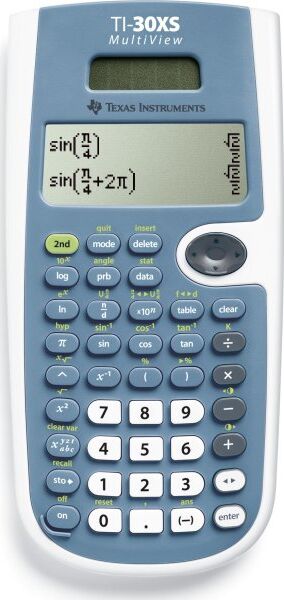
Texas Instruments Ti-30xsmv Matematisk LommeregnerTexas matematikregner TI-30XS Multi-View TI-30XS MultiView™ er den nye videnskabelige lommeregner, som kombinerer de kendte statistiske og videnskabelige funktioner fra den klassiske TI-30 med et flerlinjes (Multi-line) display. TI-30XS MultiView™ fungerer og skriver resultater, som du forventer det. Brøker skrives for eksempel på en rigtig brøkstreg som i lærebøgerne. Specifikationer De vigtige videnskabelige, trigonometriske og hyperbolske funktioner. Multi-linje skærm, så for eksempel brøker skrives naturligt, og du kan se tidligere indtastninger. To-variabel statistik: Indtast / slet / indsæt / editer individuelle statistiske data. "Equation Recall" funktion gør det muligt at genkalde, se og ændre tidligere udregninger og statistiske data. Se og tast brøker på rigtige brøkstreger, som decimaltal eller en blanding. Vælg selv. Dataeditor til at indtaste lister med data. Liste funktion: Kan anvende en funktion på en liste af værdier. Rødder vises, så du kan arbejde med rødder eksakt, og de kan bruges til at faktorisere nævneren i en brøk. Eksponenter skrives med hævet skrift (superscript). Konvertering er gjort stærkere med en Mode Menu: Indstil forskellige måder at se tal på (Grader / Notationer / flydende antal decimaler). Videnskabelig (Scientific) notation. Arbejd med variable og gem værdier i dine variable. Passer til brugere på: 7.-10. klasse, Gymnasiet og HF, HTX og HHX, Universitet Vægt: 238,3 gram373,75 DKK*Shipping: 81,19 DKKSecure redirect to the provider


-
What is the rule for the partitive article?
The rule for the partitive article in French is to use "de" followed by the definite article (le, la, les) to indicate an unspecified quantity or some of a mass noun. For example, "du" is used for masculine singular nouns, "de la" for feminine singular nouns, and "des" for plural nouns. The partitive article is used when referring to an unknown or unspecified quantity of something. **
-
What are partitive articles in the French language?
Partitive articles in French are used to indicate an unspecified quantity of a noun. They are used when referring to a portion or some of a mass noun, such as food or liquid. The partitive articles in French are "du" (for masculine nouns), "de la" (for feminine nouns), and "de l'" (for nouns starting with a vowel or silent "h"). These articles are essential for expressing the concept of some or any in French. **
-
What is the difference between drums and percussion?
Drums are a specific type of percussion instrument that typically have a hollow body and a membrane that is struck to produce sound. Percussion, on the other hand, is a broader category that includes a wide range of instruments that are struck, shaken, or scraped to produce sound. While drums are a subset of percussion instruments, percussion encompasses a variety of instruments such as cymbals, tambourines, maracas, and xylophones. **
-
How do you form the genitive partitive in Latin?
In Latin, the genitive partitive is formed by using the genitive case of the noun followed by the word "partis" or "partis" (depending on the gender of the noun) to indicate a part of the whole. For example, if the noun is "puella" (girl), the genitive partitive would be "puellae partis" to indicate "part of the girl." This construction is used to express the idea of "some of" or "a part of" something. **

What are partitive articles and quantity increases in French?
Partitive articles in French are used to indicate an unspecified quantity of a noun. They are used with uncountable nouns or when referring to a portion of something. Quantity increases in French involve using words like "plus de" (more), "beaucoup de" (a lot of), or "trop de" (too much) to indicate an increase in the quantity of something. These expressions are used to specify a larger amount of a noun compared to using just the partitive article. **
When do you use the partitive article in French?
The partitive article in French is used to indicate an unspecified quantity of a mass noun. It is used when referring to a part of a whole, or an unspecified amount of something. For example, "du" is used for masculine nouns, "de la" for feminine nouns, and "de l'" for nouns starting with a vowel or silent "h". It is important to use the partitive article when talking about food, drinks, or other uncountable nouns in French. **
Top-Angebote
Products related to Partitive:
-
Primal Rhythm Tohånds/switch Stang -# 4Rhythm - Let og præcis At mestre tohåndskastet handler i høj grad om at finde rytmen. Når først rytmen sidder, åbner der sig en verden af muligheder. Rhythm-serien er designet specielt til trout-spey på mindre åer og vandløb - ideel til steder, hvor begrænset plads til bagkastet ofte kan være en udfordring. Specifikationer: Højmoduls 55MSI klinger Optimeret til Skagit- eller Scandi-klumper Mat, lavglans stealth-sort finish UHC – Ultra Light Helical Core (ultralet spiralforstærket kerne) LNR – Longitudinal Fibre Alignment (langsgående fiberorientering) LMS – Low Mass Scrim (lavmasseforstærkning) Cordura-stangrør med bærestrop Stofpose til stangen 4-delt rejsedesign Modeller: 11' #4 - 169g 11' #6 - 184g2799,00 DKK*Shipping: 49,00 DKKSecure redirect to the provider
-
Texas Instruments Ti-1726 LommeregnerTexas Instruments TI-1726 Miniskrivebordslommeregneren med attraktiv udformning og SuperView-display. Specifikationer: Stort, 8-cifret (12,5 mm) LCD SuperView-display. Rummeligt tastatur med velplacerede gummiknapper. Knap til (+/-) Knap til kvadratrod Vinklet display gør det nemmere at aflæse. ANYLITE™ solcelledrift. Kan anvendes selv i dårligt lys. str. 80 x 110 mm Vægt: 95 gram140,00 DKK*Shipping: 81,19 DKKSecure redirect to the provider
-
How is the partitive formed?
The partitive is formed in French by using the preposition "de" followed by the definite article "le," "la," or "les." This combination contracts to form "du," "de la," or "des" before a singular or plural noun, respectively. For example, "some bread" is "du pain" and "some apples" is "des pommes." The partitive is used to indicate an unspecified quantity or portion of a mass noun. **
-
What is the French partitive article?
The French partitive article is used to indicate an unspecified quantity of a noun that cannot be counted. It is formed by combining the preposition "de" with the definite article corresponding to the noun's gender and number. For example, "du" is used with masculine singular nouns, "de la" with feminine singular nouns, and "des" with plural nouns. The partitive article is used in French to express concepts like some, any, or a part of something. **
-
What is the rule for the partitive article?
The rule for the partitive article in French is to use "de" followed by the definite article (le, la, les) to indicate an unspecified quantity or some of a mass noun. For example, "du" is used for masculine singular nouns, "de la" for feminine singular nouns, and "des" for plural nouns. The partitive article is used when referring to an unknown or unspecified quantity of something. **
-
What are partitive articles in the French language?
Partitive articles in French are used to indicate an unspecified quantity of a noun. They are used when referring to a portion or some of a mass noun, such as food or liquid. The partitive articles in French are "du" (for masculine nouns), "de la" (for feminine nouns), and "de l'" (for nouns starting with a vowel or silent "h"). These articles are essential for expressing the concept of some or any in French. **
Similar search terms for Partitive
-
Texas Instruments Ti-1795 Sv BordregnerTexas Instruments TI-1795 SV bordregner Den klassiske mini desktop-regnemaskine med store taster og ekstra stort SuperView display til hjemmet, kontoret eller forretningen. Skråtstillet LCD SuperView display med store tal (14 mm) sikrer god læsbarhed. God plads mellem tasterne, konturtaster og store profiltaster, der giver nem betjening. Skift af fortegn (+/-). Sol- og batteridrevet fungerer overalt. Mål: 14 x 12,2 x 2 cm238,75 DKK*Shipping: 81,19 DKKSecure redirect to the provider
-
Texas Instruments Ti-30xsmv Matematisk LommeregnerTexas matematikregner TI-30XS Multi-View TI-30XS MultiView™ er den nye videnskabelige lommeregner, som kombinerer de kendte statistiske og videnskabelige funktioner fra den klassiske TI-30 med et flerlinjes (Multi-line) display. TI-30XS MultiView™ fungerer og skriver resultater, som du forventer det. Brøker skrives for eksempel på en rigtig brøkstreg som i lærebøgerne. Specifikationer De vigtige videnskabelige, trigonometriske og hyperbolske funktioner. Multi-linje skærm, så for eksempel brøker skrives naturligt, og du kan se tidligere indtastninger. To-variabel statistik: Indtast / slet / indsæt / editer individuelle statistiske data. "Equation Recall" funktion gør det muligt at genkalde, se og ændre tidligere udregninger og statistiske data. Se og tast brøker på rigtige brøkstreger, som decimaltal eller en blanding. Vælg selv. Dataeditor til at indtaste lister med data. Liste funktion: Kan anvende en funktion på en liste af værdier. Rødder vises, så du kan arbejde med rødder eksakt, og de kan bruges til at faktorisere nævneren i en brøk. Eksponenter skrives med hævet skrift (superscript). Konvertering er gjort stærkere med en Mode Menu: Indstil forskellige måder at se tal på (Grader / Notationer / flydende antal decimaler). Videnskabelig (Scientific) notation. Arbejd med variable og gem værdier i dine variable. Passer til brugere på: 7.-10. klasse, Gymnasiet og HF, HTX og HHX, Universitet Vægt: 238,3 gram373,75 DKK*Shipping: 81,19 DKKSecure redirect to the provider
-
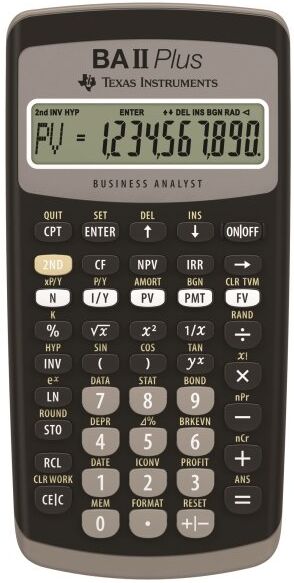
Texas Instruments Ba-Ii Plus FinansregnerTexas Instruments BA-II Plus Finansregner Ideel regnemaskine til statistik- og finansberegninger. Specifikationer Beregning af TVM (time-value-money) annuiteter, terminer, leasing/lejemål, opsparing mm. Generering af amortisationsplaner mm. Udføre pengestrømsanalyser for op til 24 forskellige pengestrømme med op til 4-cifrede hyppighede, beregner NPV og IRR. Statistik med en eller to variabler med fire regressionsindstillinger (lineær, logaritmisk, eksponentiel, og potens). Fire forskellige metoder til beregning af afskrivninger, bogført værdi og restværdi. Beregner også: balancepunkt, rentekonverteringer, delta %, avance og tab. De matematiske funktioner omfatter triognomiske beregninger, naturlige logaritmer og potenser.661,25 DKK*Shipping: 81,19 DKKSecure redirect to the provider
-
Texas Instruments Hp 17bii+ Finans LommeregnerHP 17bII+ Financial lommeregner. Finansregner især til brugere indenfor ejendomshandel og finansiering. Fysiske specifikationer LCD skærm med 2 linjer à 22 tegn. 28 KB RAM brugerhukommelse Mere end 250 nemt betjente funktioner Vælg mellem RPN og algebraisk indtastning Forretnings- og økonomiske faciliteter TVM (lån, opsparing og leasing) 3200 Cash flow funktioner – IRR NVP Annuiteter, amortisering, intern rente, aktier og afskrivning Register baseret Cash flow analyse SL DB SOYD nedskrivningsmetoder Statistik / Matematik Forecasting, valutaomregning, procenter m.m. Skriv og løs ligninger for enhver variabel Listebaseret statistik og forecasting med 2 variabler +, -, x, /, %, 1/x, +/-, 1n, SQRT x, ex, n!, yx, SUM x, SUM x2, SUM y, SUM y2, SUM xy, log, 10x, Pi, x2 Brugertilpassede faciliteter Menuer, prompts og meddelelser Ur med alarmer og aftaler HP Solve Tilbehør Infra-rød printer HP 82240B. Batterier 2 x CR2032 – varenummer GP39017.1121,25 DKK*Shipping: 31,19 DKKSecure redirect to the provider
-
What is the difference between drums and percussion?
Drums are a specific type of percussion instrument that typically have a hollow body and a membrane that is struck to produce sound. Percussion, on the other hand, is a broader category that includes a wide range of instruments that are struck, shaken, or scraped to produce sound. While drums are a subset of percussion instruments, percussion encompasses a variety of instruments such as cymbals, tambourines, maracas, and xylophones. **
-
How do you form the genitive partitive in Latin?
In Latin, the genitive partitive is formed by using the genitive case of the noun followed by the word "partis" or "partis" (depending on the gender of the noun) to indicate a part of the whole. For example, if the noun is "puella" (girl), the genitive partitive would be "puellae partis" to indicate "part of the girl." This construction is used to express the idea of "some of" or "a part of" something. **
-
What are partitive articles and quantity increases in French?
Partitive articles in French are used to indicate an unspecified quantity of a noun. They are used with uncountable nouns or when referring to a portion of something. Quantity increases in French involve using words like "plus de" (more), "beaucoup de" (a lot of), or "trop de" (too much) to indicate an increase in the quantity of something. These expressions are used to specify a larger amount of a noun compared to using just the partitive article. **
-
When do you use the partitive article in French?
The partitive article in French is used to indicate an unspecified quantity of a mass noun. It is used when referring to a part of a whole, or an unspecified amount of something. For example, "du" is used for masculine nouns, "de la" for feminine nouns, and "de l'" for nouns starting with a vowel or silent "h". It is important to use the partitive article when talking about food, drinks, or other uncountable nouns in French. **
* All prices are inclusive of VAT and, if applicable, plus shipping costs. The offer information is based on the details provided by the respective shop and is updated through automated processes. Real-time updates do not occur, so deviations can occur in individual cases. ** Note: Parts of this content were created by AI.